Understanding your federal income taxes for 2025 isn't just about meeting a deadline – it's about empowering yourself with knowledge to make smart financial decisions.
Read more: How an Ally Bank Spending Account can simplify your finances
What are tax brackets?
The United States uses a progressive tax system, which means each portion of your income is taxed at a different rate. As your income increases, you may enter different tiers, or brackets. The additional amount you make in this new tier will be taxed at a higher rate.
How do tax brackets work?
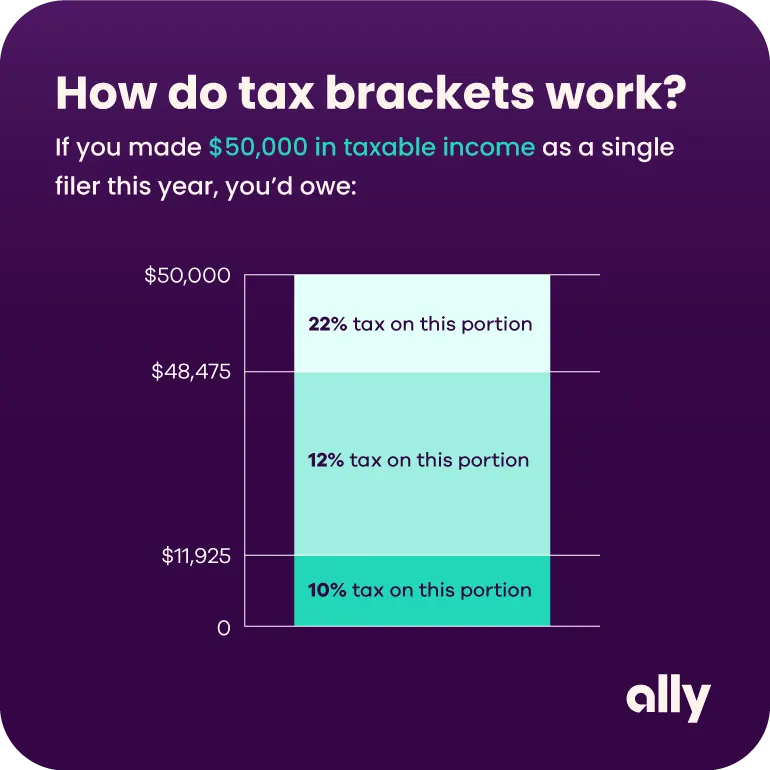
Your taxable income is not all taxed at the rate tier you fall into. Instead, you’ll be taxed in incremental tiers, with your tax bracket representing the maximum rate used to calculate what you owe.
For example, if you earn a taxable income of $50,000 in 2025, your tax is calculated this way:
The first $11,925 will be taxed at the 10% rate
The amount between $11,925 and $48,475 is taxed at 12%
The remaining $1,525 is taxed at the 22% rate
The federal income tax system has seven tax brackets — the higher your income, the more tiers you may fall into.
How do I find my tax bracket?
Tax brackets are based on your taxable income, which is the portion of your pay you’re required to pay taxes on. This number is calculated using your adjusted gross income, which differs from your annual pay in that it takes into account things like retirement savings, Health Savings Account plans and alimony payments.
Your taxable income can be found by subtracting either the standard deduction or itemized deductions from your adjusted gross income (you can estimate this amount based on the standardized deductions outlined below).
2025 tax brackets and rates
Single filers
Tax rate | Federal income tax bracket | Tax owed |
|---|---|---|
10% | $0 to $11,925 | 10% of taxable income |
12% | >$11,925 to $48,475 | $1,192.50 plus 12% of the excess over $11,925 |
22% | >$48,475 to $103,350 | $5,578.50 plus 22% of the excess over $48,475 |
24% | >$103,350 to $197,300 | $17,651 plus 24% of the excess over $103,350 |
32% | >$197,300 to $250,525 | $40,199 plus 32% of the excess over $197,300 |
35% | >$250,525 to $626,350 | $57,231 plus 35% of the excess over $250,525 |
37% | >$626,350 | $188,769.75 plus 37% of the excess over $626,350 |
Source: IRS
Married couples filing separately
Tax rate | Federal income tax bracket | Tax owed |
|---|---|---|
10% | $0 to $11,925 | 10% of taxable income |
12% | >$11,925 to $48,475 | $1,192.50 plus 12% of the excess over $11,925 |
22% | >$48,475 to $103,350 | $5,578.50 plus 22% of the excess over $48,475 |
24% | >$103,350 to $197,300 | $17,651 plus 24% of the excess over $103,350 |
32% | >$197,300 to $250,525 | $40,199 plus 32% of the excess over $197,300 |
35% | >$250,525 to $375,800 | $57,231 plus 35% of the excess over $250,525 |
37% | >$375,800 | $101,077.25 plus 37% of the excess over $375,800 |
Source: IRS
Married couples filing jointly
Tax rate | Federal income tax bracket | Tax owed |
|---|---|---|
10% | $0 to $23,850 | 10% of the taxable income |
12% | >$23,850 to $96,950 | $2,385 plus 12% of the excess over $23,850 |
22% | >$96,950 to $206,700 | $11,157 plus 22% of the excess over $96,950 |
24% | >$206,700 to $394,600 | $35,302 plus 24% of the excess over $206,700 |
32% | >$394,600 to $501,050 | $80,398 plus 32% of the excess over $394,600 |
35% | >$501,050 to $751,600 | $114,462 plus 35% of the excess over $501,050 |
37% | >$751,600 | $202,154.50 plus 37% of the excess over $751,600 |
Source: IRS
Head of household
Tax rate | Federal income tax bracket | Tax owed |
|---|---|---|
10% | $0 to $17,000 | 10% of taxable income |
12% | >$17,000 to $64,850 | $1,700 plus 12% of the excess over $17,000 |
22% | >$64,850 to $103,350 | $7,442 plus 22% of the excess over $64,850 |
24% | >$103,350 to $197,300 | $15,912 plus 24% of the excess over $103,350 |
32% | >$197,300 to $250,500 | $38,460 plus 32% of the excess over $197,300 |
35% | >$250,500 to $626,350 | $55,484 plus 35% of the excess over $250,500 |
37% | >$626,350 | $187,031.50 plus 37% of the excess over $626,350 |
Source: IRS
How to get into a lower tax bracket
Being in a lower tax bracket means you owe less money in taxes. To lower your taxable income, understand how tax deductions and credits affect how much tax you owe. Working with a tax professional can help you learn which ones you’re eligible to claim.
Tax credits
Tax credits directly lower your tax bill. For example, if you owe $1,000 in taxes and qualify for a $1,000 credit, the credit can zero out your tax liability. Some, like the Child Tax Credit, are refundable, meaning if the credit amount exceeds what you owe in taxes, you receive the difference in your refund. But if your income is higher, you may need to repay some or all of the money you received.
Tax deductions
Tax deductions reduce the amount of income that's subject to tax. They can be above-the-line (used to calculate your adjusted gross income, or AGI) or below-the-line (deducted after AGI is calculated). Above-the-line deductions include things like Individual Retirement Account (IRA) contributions and student loan interest. Below-the-line deductions are itemized deductions you claim on the Schedule A tax form, which a tax professional can help prepare.
Standard deductions vs. itemized deductions
The standard deduction is a flat dollar amount you deduct based on your filing status. Your tax advisor can help you decide if a standard or itemized deduction is the right choice for your specific situation.
Filing status | 2025 tax year standard deduction |
|---|---|
Single or married, filing separately | $15,750 |
Married, filing jointly or surviving spouses | $31,500 |
Head of household | $23,625 |
Source: IRS
Learn tax facts
Getting your tax return together shouldn't be a hassle. Whether you file on your own or work with a tax professional, staying organized throughout the year is a great way to ensure that the season doesn't sneak up on you. Happy filing!
Next in the series